
To find out whether ChatGPT cites your website, ask it the questions your customers would ask, in a clean session, and note whether your domain shows up as a source. Repeat it monthly with the same questions, and check it against your server logs, which record when ChatGPT opens your pages.
That's the short answer. Most guides stop at step one. This one covers the whole method: what each data source can and can't see, the formula we use, a tracking template, the exact commands for reading your logs, and what no tool will ever tell you. We'll walk through it with our own logs. Between August 16 and September 14, 2026, for every 150 times ChatGPT opened an auroraglobalgroup.com page to answer someone, Google Analytics recorded a single visit from chatgpt.com.
How can you tell today whether ChatGPT cites you?
There are three steps, from cheapest to most reliable. None of them is enough on its own.
- Ask it. Open a temporary chat in ChatGPT, with no memory or history, and type a question a customer would ask before buying. Write down three things: whether your domain is linked as a source, whether your brand is named without a link, and who shows up instead of you. Run the same question in Perplexity, which always shows its sources, and in Google, looking at the AI Overview.
- See who arrives from AI assistants. In the Google Analytics 4 traffic acquisition report, filter session source by chatgpt.com, perplexity.ai, claude.ai, copilot.microsoft.com, and gemini.google.com. That's the slice of citations that turns into a click, and it's small: GA4 only counts visitors who accept analytics cookies, and people can read an entire answer without clicking anything.
- Read your server logs. Every time ChatGPT fetches a page to answer someone, it leaves a line with the ChatGPT-User user agent. It's the closest thing to a citation you can measure without asking, and it doesn't depend on cookies. The commands are below.
There's a fourth source, limited to Microsoft. Since February 2026, Bing Webmaster Tools has an AI Performance report showing how often your pages appear as a source in Copilot and in Bing's AI summaries, along with the queries the engine used to find them. It doesn't cover ChatGPT, and Microsoft notes that those queries are a sample, not the full set.
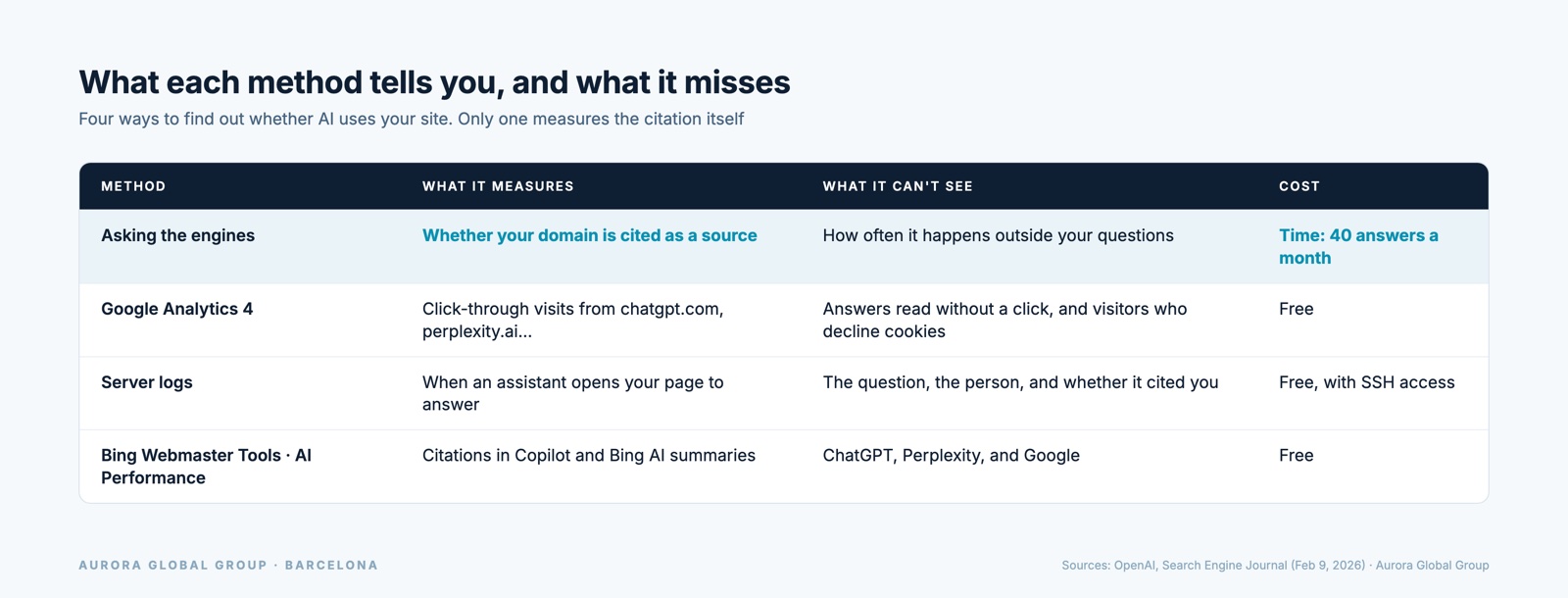
Asking the engines is the only method that measures the citation itself. GA4 measures the click that sometimes follows, logs measure when the assistant opens your page, and Bing Webmaster Tools measures citations in Copilot and Bing only.
What metric should you use to measure citations?
At Aurora we use citation rate: the number of answers that cite your domain, divided by the number of questions times the number of engines.
citation rate = answers citing your domain ÷ (questions × engines)
Ten questions across four engines gives you forty answers. If your domain is cited as a source in six, your citation rate is 15%. We explain it in more depth in what GEO is, and it's the number every engagement of our GEO service starts with.
Three rules make it useful:
- Count citations, and log mentions separately. A citation is your URL shown as a source; a mention is your brand named in the text with no link. Unlinked mentions usually come from a third party, like a directory, a ranking, or a forum, and that third party is where the work is.
- Benchmark against two competitors, because there's no published threshold. We haven't found any study that says what a good citation rate looks like in a given industry, and we're not going to make one up. What does work as a reference is the gap: if a competitor is cited fourteen times in the same forty answers and you're cited twice, closing that gap is the goal, and next month shows whether it narrowed.
- Track a monthly series. A generative engine's answers change from one run to the next even when the question is identical, so a single measurement tells you nothing. The trend over several months with the same questions does.
Tracking template: ten questions, four engines
Lock the wording of each question in the first month and don't change it. Adding a new question is fine; editing an existing one breaks the series and leaves you with no history to compare against.
Here's how we split the ten:
- three discovery questions, such as "which [service] company would you recommend in [area]?";
- three comparisons between options your customer is weighing;
- two about price or timelines;
- two technical ones, the kind a specifier or an experienced buyer would ask.
Pull them from what your customers already ask in emails, sales calls, and meetings, and from the related questions Google shows for your industry.
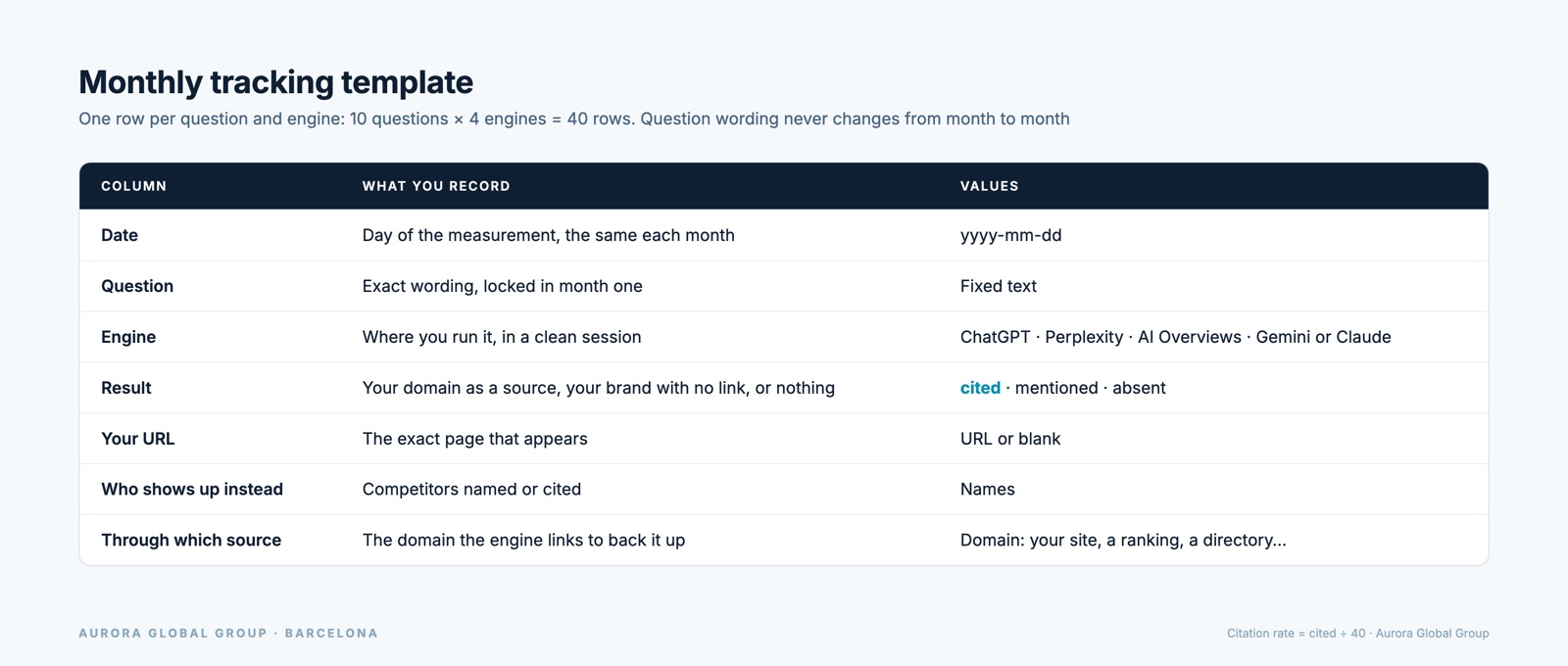
Each row is one question in one engine, with seven columns: date, question, engine, result (cited, mentioned, or absent), which of your URLs appears, who shows up instead of you, and through which source. The last column is the one that creates the most work. If a competitor wins through a ranking on someone's blog, the job is on that ranking, outside your site. Our own Perplexity check on September 3, 2026, showed exactly that: two of the agencies it recommended in Barcelona were also the cited source, with a ranking published on their own websites.
How do you see whether AI bots are visiting your site?
In your server's access log. Before you count anything, know that each company runs several crawlers, and each one visits for a different reason.
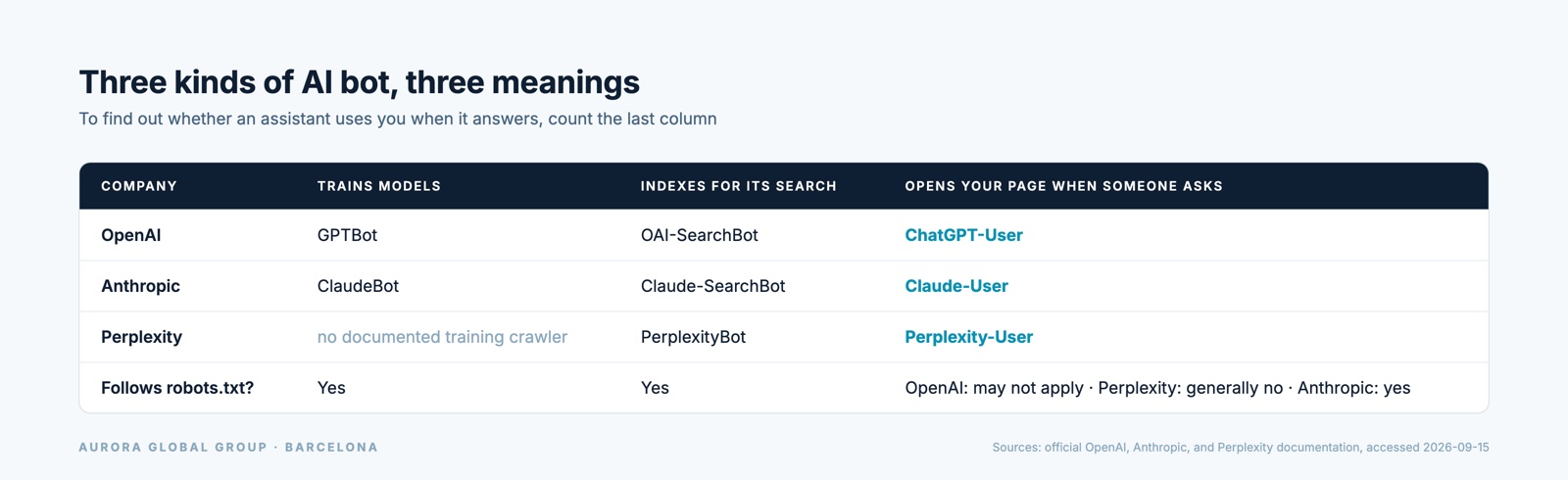
OpenAI uses GPTBot to train models, OAI-SearchBot for its search, and ChatGPT-User when a person asks ChatGPT for something. Anthropic splits things the same way with ClaudeBot, Claude-SearchBot, and Claude-User, and Perplexity separates PerplexityBot from Perplexity-User. To find out whether an assistant uses you when it answers, count the third group: ChatGPT-User, Claude-User, and Perplexity-User. A visit from one of them means someone asked a question and the assistant opened your page to answer it. It doesn't guarantee a citation, and one question can open several pages, but it's as close to a citation as you can get without asking.
With SSH access to your server, this command counts requests by crawler. On Plesk hosting the log is called access_ssl_log; elsewhere it's usually access.log:
grep -oE "GPTBot|OAI-SearchBot|ChatGPT-User|ClaudeBot|Claude-SearchBot|Claude-User|PerplexityBot|Perplexity-User" access_ssl_log | sort | uniq -c | sort -rnAnd this one lists the pages ChatGPT opened to answer someone, most-visited first:
grep "ChatGPT-User" access_ssl_log | awk '{print $7}' | sort | uniq -c | sort -rn | head -20If your log is compressed by daily rotation, swap grep for zgrep. Two cautions before you trust the number. User agents can be spoofed: some scanners pose as ChatGPT while probing for config files, so throw out paths like /.env or /.git. And if you need certainty, OpenAI publishes the IP ranges for each of its bots as JSON files, such as openai.com/chatgpt-user.json, which you can match against the IP on each line. If every count comes back zero, the problem may be upstream: many CDNs and firewalls return a 403 to these crawlers without anything showing up in robots.txt. To rule it out, check your site with our AI visibility checker, which requests your page with the GPTBot, OAI-SearchBot, ClaudeBot, and PerplexityBot user agents and compares the response with a regular browser's.
What won't you be able to find out?
Four things are out of reach for any method, and it's worth knowing them before you pay for a tool that claims otherwise.
- How many times ChatGPT has cited you in total. OpenAI doesn't offer publishers a citation dashboard. The only number available is the one you get by asking.
- What the person asked. Your log shows which page the assistant opened and when. The question and who asked it stay on the provider's servers, which is where the request comes from.
- Your AI Overview appearances, from Search Console. Search Console folds them into regular web results and doesn't break them out. We cover this in Google AI Overviews.
- Answers that come from memory. When a model answers from what it learned in training, without searching, your server records nothing. GPTBot and ClaudeBot do leave a trace when they collect training content, but months earlier and unrelated to any question.
A worked example: thirty days of auroraglobalgroup.com
Measured on September 15, 2026, from our server logs for August 16 through September 14, using the two commands above, without IP verification.
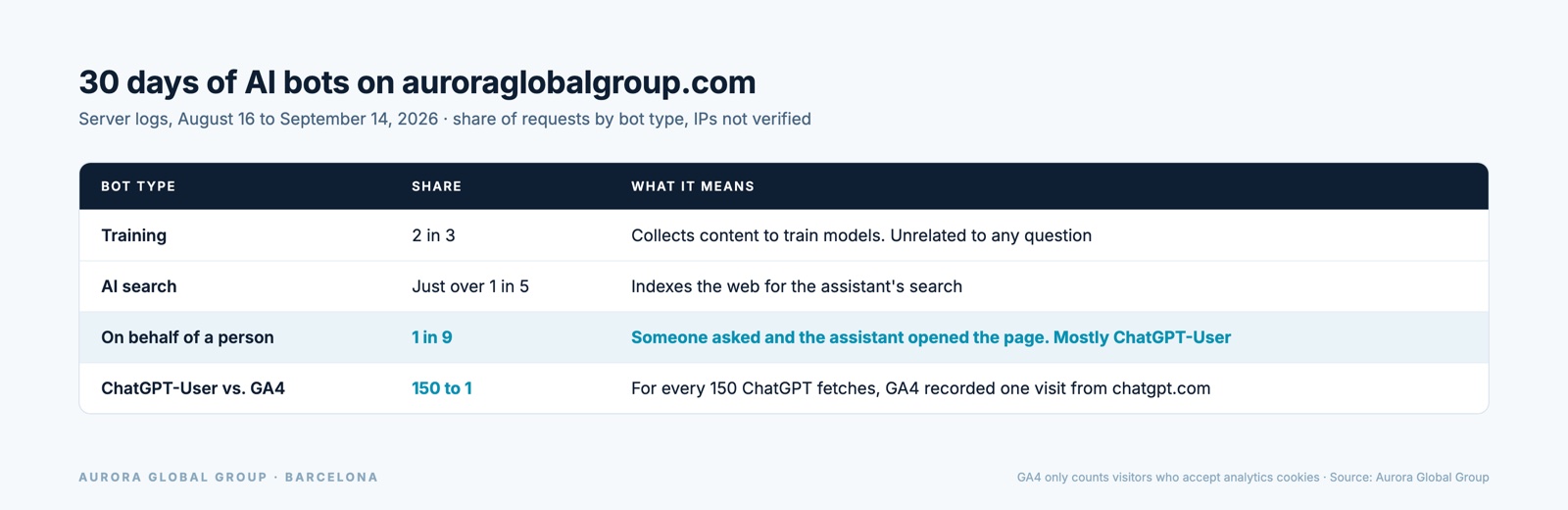
Over thirty days, two out of three AI bot requests came from training crawlers, just over one in five from AI search crawlers, and one in nine from agents acting on behalf of a person, most of them ChatGPT-User.
Three takeaways.
Most AI bot traffic has nothing to do with citations. A single training crawler, ClaudeBot, made more requests than every other bot combined.
GA4 can't see what happens inside ChatGPT. For every 150 ChatGPT-User requests, analytics counted one visit. This data can't separate the two causes of the gap: GA4 only counts visitors who accept analytics cookies, and an answer can be read without clicking the link. Anyone looking only at GA4 would conclude ChatGPT doesn't know them.
What it opens shows what it uses. Three out of four pages ChatGPT successfully opened were our homepage or our generative engine optimization guide in English. The rest were one-off visits. That's what the assistant reads when people ask about us, and, by omission, what it doesn't.
We'll publish the other half of the method, asking, once we have our first full series of questions across the four engines.
FAQ
Does ChatGPT have a tool that shows whether it cites my website?
No. OpenAI documents its crawlers and publishes their IP ranges, but it doesn't offer publishers a citation report. Microsoft does offer one for Copilot, in Bing Webmaster Tools.
If I block GPTBot, will I disappear from ChatGPT?
According to OpenAI's documentation, GPTBot collects content to train models; ChatGPT search uses OAI-SearchBot, and user requests use ChatGPT-User. Blocking GPTBot in robots.txt keeps your content out of training without blocking the other two, which you configure separately. OpenAI also notes that because ChatGPT-User requests are initiated by a person, robots.txt rules may not apply.
Is a ChatGPT-User visit a citation?
Not necessarily. It means ChatGPT opened your page to answer someone. Whether it then cited or discarded it, you can only find out by asking the engine.
Why does ChatGPT cite me one day and not the next?
Because generative answers aren't deterministic: the same question produces different text and different sources. That's why you track a monthly series with fixed questions instead of a one-off query.
How often should I measure?
Once a month, on the same day, with the same questions. You can check your logs whenever you like, since they accumulate on their own.
What should I do if it doesn't cite me?
First, confirm the crawlers can get in. Then make sure your pages answer in their first few sentences, with data and sources, as we explain in SEO for AI. Finally, look at the "through which source" column in your template: if someone else wins through a directory or a ranking, that's where the work is.
OpenAI, Overview of OpenAI Crawlers (developers.openai.com), accessed September 15, 2026.
Anthropic, Does Anthropic crawl data from the web, and how can site owners block the crawler? (support.claude.com), accessed September 15, 2026.
Perplexity, Perplexity Crawlers (docs.perplexity.ai), accessed September 15, 2026.
Search Engine Journal, Bing Webmaster Tools Adds AI Citation Performance Data (February 9, 2026).
auroraglobalgroup.com server access logs and Google Analytics 4, August 16 to September 14, 2026.
Our own Perplexity check, September 3, 2026.
How we handle it at Aurora
If you don't yet know whether AI assistants can read your site, start there: the AI visibility checker is free and takes twenty seconds.
If you want the full series (ten questions from your industry, four engines, who shows up instead of you, and through which source), it's the first measurement in our GEO service.