
GEO (Generative Engine Optimization) is the work of getting an AI search engine — ChatGPT, Perplexity, Google's AI Overviews — to cite your site inside the answer it writes. It isn't after a spot on a list. It's after a mention.
That's the short definition. The rest of this page covers where the term came from, how it differs from SEO and AEO, how a generative engine picks its sources, what number you measure it with — the part almost nobody covers — and how to decide whether it's your turn yet.
We wrote this after measuring, on September 9, 2026, the eleven Spanish-language queries people use to search this topic in Spain. All eleven return an AI Overview block in first position. Not one leaves the top organic result at the top.
What GEO means, and what it doesn't
GEO stands for Generative Engine Optimization. A generative engine is a system that writes an answer and cites a few sources instead of returning ten links. ChatGPT, Perplexity, Gemini, Copilot, and the AI Overviews block Google puts above its results all work this way.
There's a second discipline abbreviated GEO that has nothing to do with this one: geomarketing, the analysis of georeferenced data to decide where to open a store or how to split a sales territory. The confusion is real and measurable. When we ran the query "geo marketing" on Google Spain, four of the eight organic results in the top 10 were about geomarketing — Wikipedia, NielsenIQ, Universidad Europea — and the other four were about generative engines. On "geo posicionamiento," one top-20 page defines GEO as local search. If you came here looking for how to rank your business on a map, this isn't your page.
The confusion has an explanation: the newer sense of the term is recent and has grown fast. In July 2024, "geo seo" was searched ten times a month in Spain. Today it's 590. "Posicionamiento geo" had no measurable volume until April 2025 and now runs around 260 searches a month. That's OpenSEO data for the Spanish market, pulled September 9, 2026, and it describes a term that went from nonexistent to more than 2,000 monthly searches across its variants in two years.
There's a third confusion, this one internal to the industry: some people call GEO what others call AEO (Answer Engine Optimization) or simply SEO for AI. The three names describe jobs that overlap heavily. The table in the next section separates what each one is actually after.
The term has a specific origin and date. A team from Princeton and Georgia Tech coined it in a paper presented at KDD 2024, which also measured how much each tactic improves visibility. We break that down in our generative engine optimization guide.
How GEO differs from SEO and AEO
The difference that matters isn't in the techniques, which overlap heavily. It's in what each discipline counts as a result.
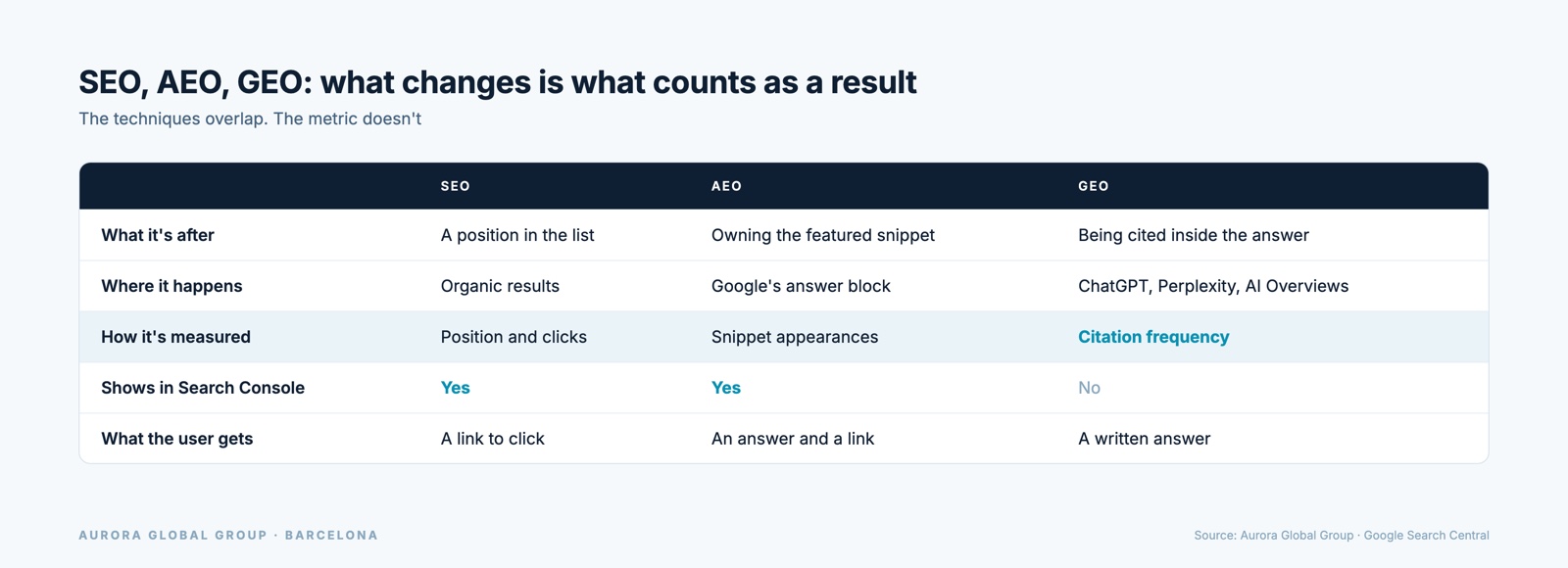
Short version: SEO goes after a position in the results list and is measured in clicks. AEO goes after the featured snippet and is measured in appearances. GEO goes after being cited inside a generative answer and is measured in citation frequency. All three share the same technical base — clear content, a crawlable site, authority — and they overlap on purpose.
One objection is worth recording here, because it's published and well argued. A BBVA article on the shift from SEO to GEO, currently ranking fifth organically for "geo seo" in Spain, quotes the position that GEO doesn't exist as a standalone approach and is "a new label for something that's already part of SEO."
It's a fair criticism of how GEO gets sold, and a weak description of what gets measured. If two jobs share an objective, they share the number that tells you whether they're working. SEO has had that number for twenty years: position and impressions in Search Console. GEO doesn't show up there. Search Console doesn't separate AI Overview appearances from the rest, and ChatGPT and Perplexity report nothing at all. Work whose result doesn't fit in the previous job's dashboard needs its own dashboard, however much the tactics overlap. The full comparison between the two is in GEO vs SEO.
How a generative engine works under the hood
A generative engine doesn't query an index and sort it. It does three things in sequence:
- It rewrites your question. "Which SEO agency would you recommend in Barcelona?" becomes several different searches the user never sees.
- It retrieves a handful of documents for each of those searches, from its index or from the live web.
- It writes an answer from those documents and links some of them.
GEO operates on steps 2 and 3: you have to be among the retrieved documents, and you have to be citable enough that the model actually uses you when it writes. Content can clear the first filter and fail the second, which is what happens to most corporate pages: the engine finds them and doesn't cite them, because there's no sentence in them it can pull out and attribute.
That second filter deserves a moment, because it's where most corporate content falls down. A model writes by attributing: it needs a sentence it can reproduce and hang on a source. A page that says "we're a leader in waterproofing solutions" gives it nothing to attribute. A page that says "the system cures in four hours and isn't recommended on roofs pitched steeper than 15%" gives it two citable claims. The first is written so a visitor leaves with an impression. The second is written so a third party repeats it. GEO is largely about writing the second kind. That's where the formatting rules every guide repeats come from: a short answer paragraph up top, headings phrased as questions, tables, sourced numbers. That's why they work. It isn't style. It's what makes text extractable.
One detail of step 2 goes almost unmentioned and changes the strategy. Generative engines mostly don't cite brands. They cite whoever writes about brands. We checked this on our own agency, and the result is in the worked example below.
On Google's block specifically — when it shows up, how it picks who it cites, and how to check whether a search triggers it without paying for a tool — we have a dedicated piece: Google AI Overviews.
How to measure GEO
This is where most of the literature stops. We reviewed the top twenty results for the three main queries in this family, and not one page proposes a number. They say "measure your AI visibility" and move to the next section.
The metric we use at Aurora is citation frequency:
citation frequency = answers that cite your domain ÷ (number of questions × number of engines)
Here's how you run it:
- Fix 10 to 20 questions a real customer would ask. Not keywords: questions. "Which company would you recommend for industrial roof waterproofing in Catalonia?", not "roof waterproofing."
- Fix the engines. Four cover the Spanish market: ChatGPT, Perplexity, Google AI Overviews, and either Gemini or Claude depending on your audience.
- Run every question on every engine and record one thing: whether your domain shows up cited or linked. Yes or no.
- Divide. Ten questions across four engines is forty answers. Cited in six of them, your citation frequency is 15%.
- Repeat on the same day each month, with the same questions. The absolute value matters little. The series matters a lot.
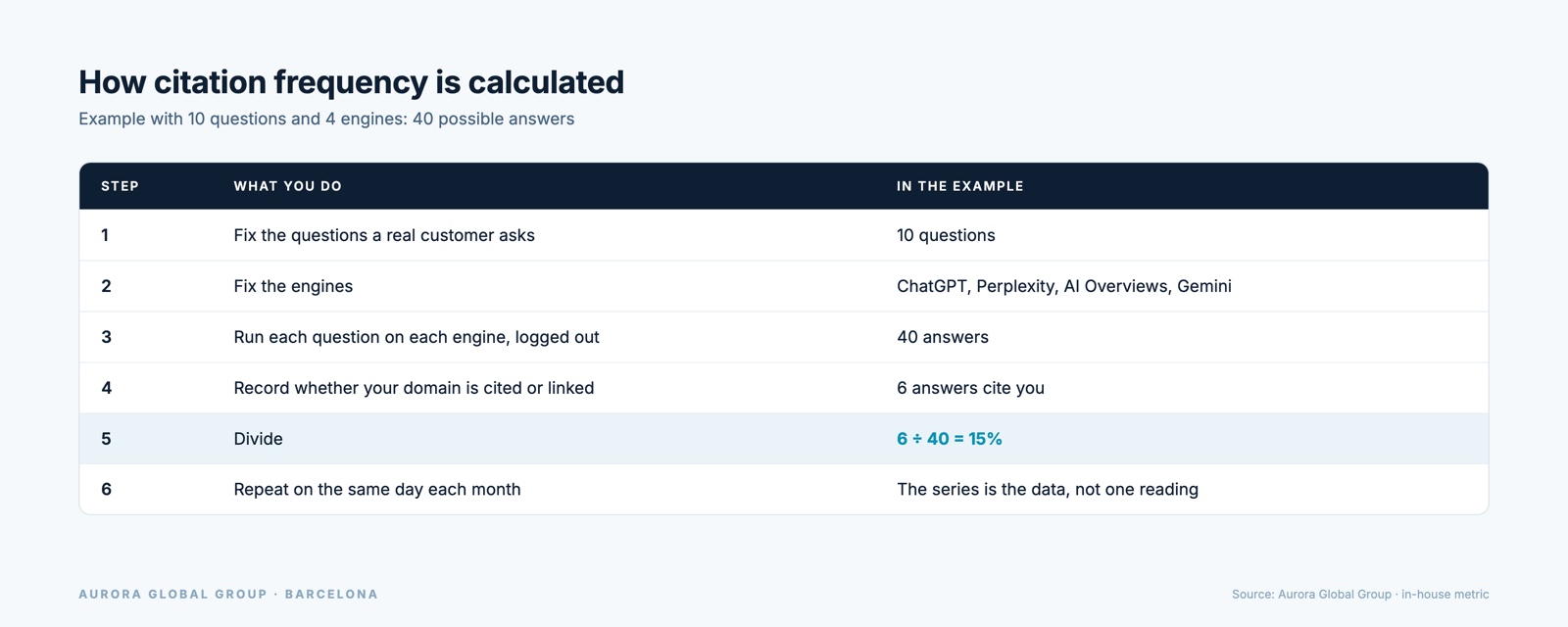
Ten questions across four engines is forty possible answers; six citations is a citation frequency of 15%.
Three warnings about this number, because it helps to know what it doesn't do. Generative answers aren't deterministic: the same question can produce two different answers, so a single reading means nothing and a series means something. Session state matters: measure logged out, in a clean window, or you're measuring your own footprint. And it isn't traffic: citation frequency measures presence in the answer, not visits.
That last distinction clears up more confusion than any other, and there's a Spanish data point that illustrates it. According to SE Ranking's study of AI traffic in Spain, published June 17, 2026 across 101,574 sites with valid analytics, AI platforms drove 0.30% of Spanish web traffic in 2026, up from 0.23% the year before. That's a small number. Over the same period, organic search fell from 52.02% to 40.70% of total traffic in Spain: eleven points, against 2.59 points of decline worldwide.
Read them together: AI still sends very few visits, and the channel that used to send them is shrinking fast in this market. GEO isn't a traffic channel today. It's how you keep existing where people are starting to ask. That's how we scope our GEO service: measuring citation from month one, not promising visits the channel doesn't deliver yet.
Does your company need GEO yet?
Not everyone's turn comes at the same time. Four signals, and two are enough.
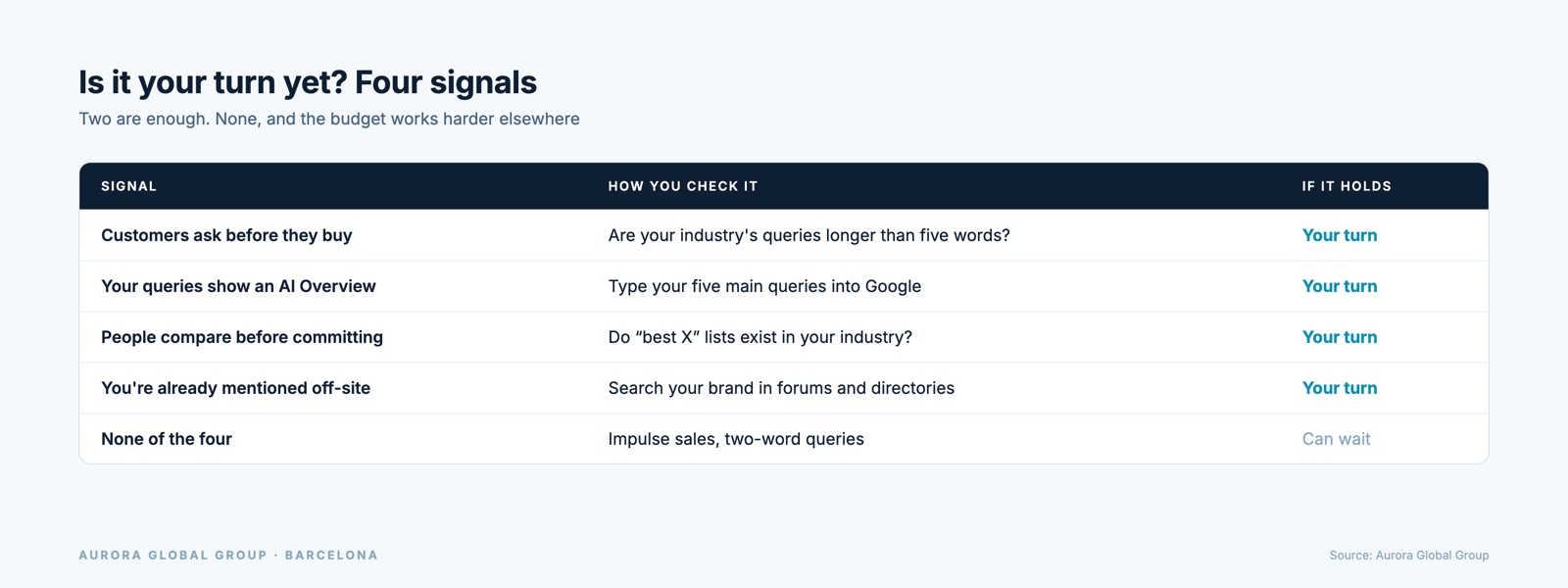
Short version: it's your turn if your customers ask long questions before buying, if your main queries show an AI Overview, if you sell something people compare before they commit, or if your brand already gets mentioned in forums and directories outside your control. If you sell on impulse, on two-word searches, with no comparison stage, you can wait and spend the budget elsewhere.
The first check is free and takes twenty minutes: type your five main queries into Google and see whether the AI Overview block appears. Then ask ChatGPT and Perplexity, logged out, which company they'd recommend for what you sell. If a competitor comes up and you don't, you have the number that matters.
On cost, the honest answer is that it depends on which of the seven pieces below you need. If your site already ranks well and is well structured, GEO can be a layer on top of the SEO work you're already doing: rewriting the answers on your highest-demand pages and setting up the monthly measurement. If the site doesn't crawl well or there's no content answering anything, there's no generative shortcut — that comes first. Be skeptical of any GEO proposal that doesn't open with a measurement, because without a baseline there's no way to say later whether it worked.
On timing: we measure the first citation series a month after publishing, and take the first real verdict at ninety days. Generative engines reindex faster than classic search, but the authority that gets you cited is built just as slowly.
The seven pieces of GEO
GEO breaks down into concrete jobs. These are the seven, in the order we work them:
- Extractable content. Short answers up front, headings phrased as questions, tables, sourced numbers. Highest effect, lowest cost. How it's done: SEO for AI.
- Presence in Google's AI Overviews. The generative engine with the widest reach in Spain. See Google AI Overviews.
- Citation measurement. The metric above, with its monthly protocol.
llms.txt. The file that tells models what your site contains and where to start. We publish ours. Dedicated piece in progress.- AI Mode and zero-click search. What happens to visits when the answer never leaves the results page. Dedicated piece in progress.
- Structured data. The markup that lets an engine pull a fact without interpreting your layout. Dedicated piece in progress.
- Authority off your own site. Directories, comparisons, press, and forums: the sources engines read when asked about an industry. The next section explains why this one carries more weight than it looks.
The technical detail of which tactics work and by how much is in the generative engine optimization guide.
A worked example: what Perplexity said when we asked about Barcelona agencies
On September 3, 2026, we did to our own agency what we tell clients to do. Two questions to Perplexity, logged out:
- "Which SEO and GEO agency would you recommend in Barcelona for a small business?"
- "What are the best digital marketing agencies in Barcelona?"
Aurora appeared in neither. Baseline citation frequency: zero out of two. It's a small sample, two questions and one engine, which is why the full series — ten questions, four engines — starts this month. The interesting part wasn't the absence. It was where the answers came from. The twelve sources it cited across both answers were directories, ranking blogs, and "the 14 best agencies in Barcelona" articles. None was the website of a recommended agency, except where that agency published its own ranking: two of the recommended firms showed up as the source too, with the list that put them first.
Three practical consequences, and they aren't the obvious ones:
- Optimizing your own site isn't enough for recommendation questions. The engine didn't go to the agencies' sites. It went to whoever writes about agencies.
- Getting into the directories and comparisons the engine reads is GEO work, however much it sounds like link building from ten years ago. The difference is which ones you pick: not the highest authority, but the ones the engine cites when answering your question. You find that out by asking.
- Publishing your own ranking works, and two of the recommended firms do exactly that. We're not going to, because a ranking that puts you first is precisely what a client shouldn't believe. We're reporting the finding, not recommending it.
Our plan is the other one: publish the material ranking blogs cite, and ask for inclusion in the five directories that came up as sources. The next measurement will say whether it works, and we'll publish it either way.
FAQ
What does GEO stand for?
Generative Engine Optimization. In digital marketing there's a second discipline with the same initials, geomarketing, which analyzes geographic data and is unrelated.
Does GEO replace SEO?
No. They share a technical base: a site Google can't crawl, models can't read either, and the pages generative engines cite usually rank well already. GEO adds an objective — being cited — and a metric, citation frequency, that SEO doesn't have.
How are SEO, AEO, and GEO different?
SEO goes after a position in the results list. AEO goes after the featured snippet with a direct answer. GEO goes after being cited inside the text a generative engine writes. The techniques overlap; the results are measured differently.
How do I know whether ChatGPT or Google cite my site?
Ask your ten main queries on each engine, logged out, and record whether your domain appears. For Google's block, check on the search itself whether an AI Overview shows and which sources it links. Repeat on the same day each month.
How long does GEO take to work?
You can measure the first citation series after a month. A verdict worth acting on takes ninety days. Engines reindex fast; the authority that gets you cited doesn't.
Do I need llms.txt or structured data to get cited by AI?
They help, and they aren't required. Google states in writing that structured data isn't required to appear in its AI features. Clear content with extractable answers and real sources counts for more than any file.
Aggarwal, Murahari et al., GEO: Generative Engine Optimization, KDD 2024 — the paper that coined the term and measured the tactics.
Google Search Central, Optimizing your site for generative AI features — Google's official position.
SE Ranking, AI traffic in Spain: data and trends 2026 (June 17, 2026), 101,574 sites analyzed between January 2025 and April 2026.
BBVA, From SEO to GEO: AI redefines content positioning (July 10, 2025) — the objection quoted in the differences section.
OpenSEO, Spanish volume and SERP data pulled September 9, 2026.
Our own measurement in Perplexity, September 3, 2026.
How we work GEO at Aurora
We start by measuring: ten questions, four engines, a baseline citation frequency. From there, extractable content and presence in the sources engines read. Every month we measure again with the same questions, and the number moves or it doesn't.
If you want to see that number for your site, here's how we work GEO.