The difference between SEO and SEM is how you pay for visibility on Google. SEO works on your site to earn organic rankings, which cost nothing per click but take months to arrive. SEM buys ads on those same searches: they show up on day one, and you pay for every click.
Most guides that answer this question repeat the same table (organic vs. paid, slow vs. fast) and stop there. What actually decides between the two is a pair of numbers anyone can look up: what a paid click costs on your search, and how hard that search is to rank for organically. On September 29, 2026, we measured both for twelve real searches on Google Spain, across very different businesses, from a Barcelona accounting firm to invoicing software. This article lays out the results: what it costs to buy a hundred clicks in each case, the rule we use to decide, a worked example built on the search that brings us our own clients, and what changes now that Google answers with AI above both the ads and the organic results.
What are SEO and SEM?
SEO (search engine optimization) is the work you do on a website so it shows up in Google's free results when someone searches for what you offer. SEM (search engine marketing), as most people use the term today, means paid search ads: mainly Google Ads and, to a lesser extent, Microsoft Advertising, which serves the ads on Bing. Both compete for the same results page under different rules. In SEO, Google ranks pages by relevance and quality, and it states in writing that it doesn't charge to appear in search results or give better rankings to advertisers. In SEM, an ad's position comes out of an auction that runs again on every search, combining your bid, the quality of the ad and its landing page, and the context of the person searching.
For years, SEM was used as an umbrella term that included SEO, and some people still use it that way. In agency practice, and in this article, SEM means paid ads on a search engine, and the comparison that matters is between what you earn through work and what you buy with budget. There's a third layer worth naming up front, because it's changing how clicks are split between the other two: the AI-generated answers Google places above everything else, called AI Overviews, and assistants like ChatGPT and Perplexity, which answer without showing any Google ads. We cover it at the end of this article, and in depth in our guide to what GEO is.
How are SEO and SEM different?
They differ in four ways: what you pay for, when results arrive, what's left when you stop spending, and how your position is decided. With SEO you pay for work (technical fixes, content, authority) and the clicks are free; with SEM you pay for every click. SEO takes three to six months to deliver measurable results, and six to twelve to hold competitive rankings. An ad goes live the day you turn it on, although a campaign needs four to eight weeks of data before you can tune bids and judge profitability with any confidence. When you stop SEO, what you built keeps working for months and erodes slowly. When you stop SEM, the traffic is gone that afternoon. And an organic position can't be bought, while an ad position gets renegotiated on every search.
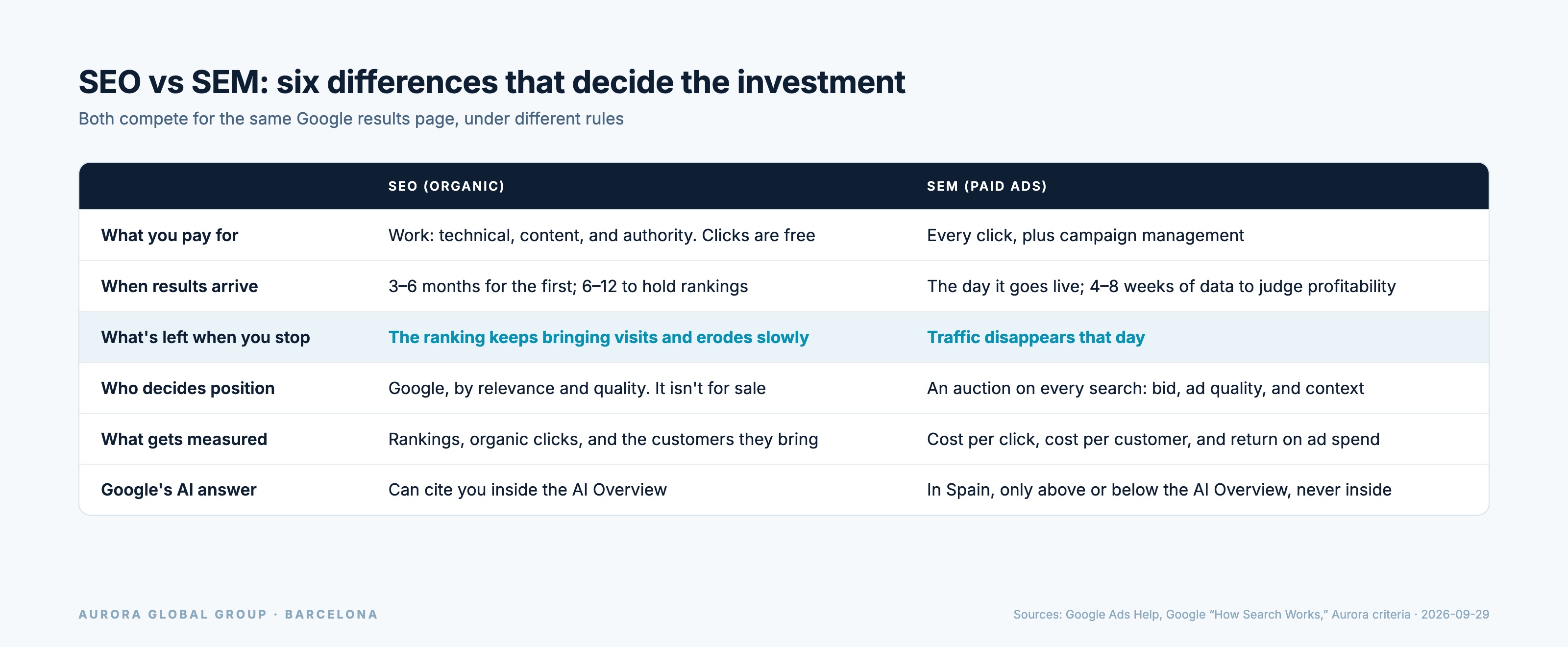
The difference that matters most on a P&L is the third one. A euro spent on SEM buys one click and is gone with that click. A euro spent on SEO buys a page that keeps getting visits as long as it holds its ranking, and every organic visit is a click you don't pay for. That's why comparing SEO and SEM on first-month cost always makes SEM look better, while comparing them over two years usually favors SEO on searches you can actually rank for. That last condition is the one most comparisons leave out. On some searches, ranking organically is very expensive or close to impossible for a mid-sized company, and there SEM is the only realistic way to show up.
How much does an SEM click cost by industry?
It varies so much by industry that an average tells you nothing: across the twelve searches we measured, a click ranges from €2.35 to €24.27. A click on "veterinario barcelona" (vet in Barcelona) costs €2.35; on "programa de facturación" (invoicing software), €24.27, ten times as much. In between sit "abogado laboralista barcelona" (employment lawyer, €5.98), "gestoría barcelona" (accounting and payroll firm, €6.53), "fontanero barcelona" (plumber, €8.01), and "seguro de salud" (health insurance, €11.31). These are DataForSEO's estimated Google Ads cost-per-click figures for Google Spain, pulled through OpenSEO on September 29, 2026. The figure translates them into a number that lands better in a meeting: what it costs to buy a hundred visits from each search. In small-business management software, a hundred clicks run over €2,300. A hundred clicks aren't a hundred customers, and the conversion rate depends on the business.
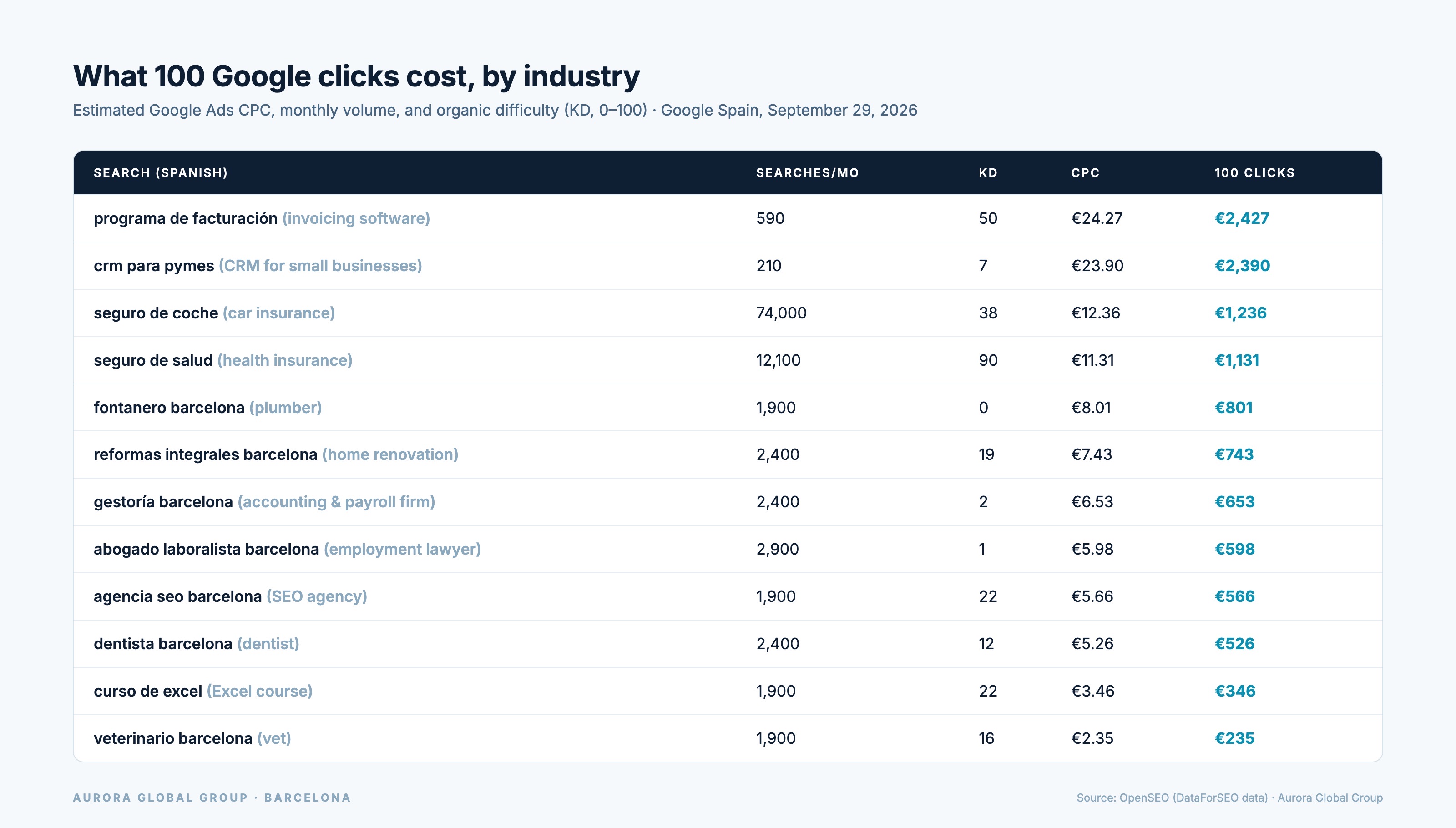
CPC moves with the competition in the auction, and today's estimate doesn't guarantee tomorrow's price. We know this from our own search. In July 2026 we measured a paid click on "agencia seo barcelona" (SEO agency Barcelona) at €12.40, and that's the figure we published on our service page. On September 29, the same source put it at €5.66, and we updated the page that day. The price fell by more than half in ten weeks without anything changing on our site. For a business that lives on SEM, that volatility cuts both ways: a campaign that was profitable in July can stop being profitable in November because a competitor with a bigger budget enters the auction. Organic traffic has no auction, and its cost per visit keeps dropping the longer you hold the position.
How do you choose between SEO and SEM?
Cross the cost of a click with how hard the search is to rank for: if the click is expensive and the difficulty is low, SEO is the better investment; if both are high, SEM is the way to own the head term. That's the rule we apply in audits, with two working thresholds of our own. We call a click expensive when a hundred visits cost more than €500, and we call a search reachable when its organic difficulty (KD, 0 to 100) is 30 or lower. Those two cuts produce four boxes, and each one calls for a different mix. Google Ads' Keyword Planner gives you the estimated CPC for your searches, and SEO tools like the one we used here give you the difficulty. From there it gets adjusted for the site's real authority, the business's margins, and how long a customer takes to convert.
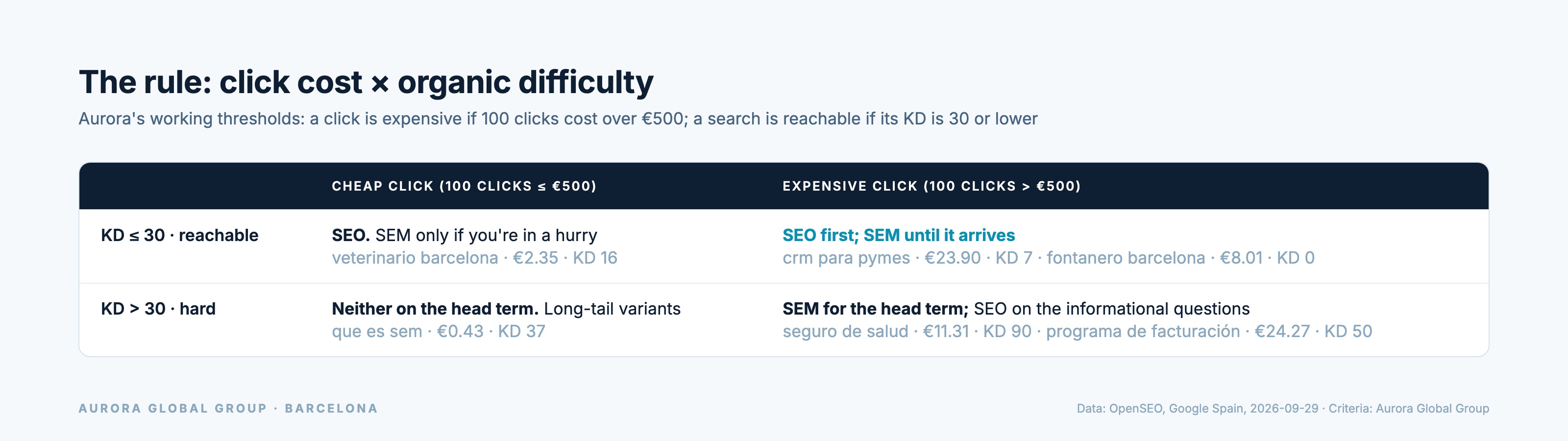
The box that saves the most money is the first one. "crm para pymes" (CRM for small businesses) costs €23.90 a click and has a difficulty of 7: a well-built page can take that position within months and save its monthly cost. "fontanero barcelona" and "gestoría barcelona" fall in the same box, with difficulties of 0 and 2. At the other end, "seguro de salud" has a difficulty of 90: the pages in its top 10 carry so much link authority that a new company won't rank for it organically in any reasonable timeframe. There, SEO targets the informational questions around it. That's the territory of a health blog like the one run by the insurer in one of our SEO case studies, whose most-read article brought in 237,000 clicks in a year. Our approach to the organic side is on our SEO services page.
How much does it cost to buy what SEO gets for free? A worked example
Buying 300 visits a month from "abogado laboralista barcelona" with ads costs €1,794 a month in clicks, €21,528 a year, before paying anyone to manage the campaign. The search gets 2,900 queries a month, a click costs €5.98, and its difficulty is 1 out of 100, so those 300 visits are one in ten searches. That's straight arithmetic on the September 29 CPC; the real price depends on the auction, the time of day, and the quality of the ad. The same demand can be met with a well-built service page and a properly managed Google Business Profile. Every visit that arrives that way is one of those 300 the firm no longer pays for, month after month, for as long as it holds the position.
With the number on the table, the useful question becomes how many months of SEO cost the same as a year of clicks, and how long it takes to reach the ranking that replaces them. On a search like this one, with almost no organic competition, the answer usually favors SEO by a wide margin, and SEM makes sense for the first few months while organic catches up. On "programa de facturación," with a difficulty of 50 and a €24.27 click, the same math gives a different answer: organic will take much longer, and the paid campaign, expensive as it is, is what brings in customers this quarter. The rule puts numbers on the decision; the decision still belongs to the business, which knows its margins and its sales cycle better than any tool.
When should you run SEO and SEM together?
Almost always, when the business needs customers this quarter and wants to lower its acquisition cost a year out. SEM covers the months when SEO isn't delivering yet, and it doubles as a lab: within weeks it shows which searches convert, which messages get clicks, and which pages close, data that SEO would take months to surface. That information tells you which organic pages to build first. Once an organic page settles into the top 3 for a search, you can scale back the campaign on that search and move the budget to the next one. We call it a progressive shift toward organic, and it's how we run our paid media work: you pay for an ad while you need it, not out of habit.
There's one commercial detail worth knowing before you ask anyone for advice. The industry's standard model is to charge a percentage of the ad spend being managed, and under that model, telling you to cut your ad budget and put it into SEO costs the agency revenue. It's an incentive, and it works on people whether or not anyone means it to. At Aurora, paid media fees are a fixed monthly amount with no commission on ad spend, so recommending that you move budget from Google Ads to organic doesn't cost us anything. Whoever advises you, ask how they get paid before you ask what they recommend, and ask for the recommendation to come with the cost per click and the difficulty of your searches, in writing.
What changes with AI Overviews and AI search?
What changes is that an AI-written answer now sits above both the ads and the organic results, and that answer cites organic sources, not ads. On September 29, 2026, both searches behind this article, "diferencia seo y sem" and "seo vs sem," opened with an AI Overview in the top position on Google Spain. According to Google Ads documentation, ads can appear above or below an AI Overview in every market where AI Overviews exist, but ads inside the answer are available only in English, in a list of twelve countries that includes the US and doesn't include Spain. For a Spanish company today, the space inside the AI answer can only be earned with organic content worth citing. We cover this in detail in our guide to Google AI Overviews.
Outside Google, the trend points the same way. ChatGPT and Perplexity answer without Google Ads, so an SEM campaign won't get you into their answers. What does count are the pages those assistants find and consider reliable, with data and structure they can quote. That's built with the same tools as SEO plus a few of its own, in the discipline now being called GEO. If you want to see where it overlaps with SEO and where it parts ways, we lay it out in GEO vs SEO. For the decision in this article, the takeaway is concrete: an SEM budget buys visibility on the classic results page, and SEO also buys the chance to be the source the AI quotes.
FAQ
Which is better, SEO or SEM?
Neither is better across the board: it depends on the cost of the click and how hard your search is to rank for. If the click is expensive and the search is rankable, SEO pays off better over a year. If high-authority sites own the search, SEM is how you show up. And if you need customers this month, SEM is the only one that gets there in time.
How long does SEO take to work compared with SEM?
SEO delivers measurable results in three to six months and holds competitive rankings in six to twelve. An SEM ad goes live the day you turn it on, although the campaign needs four to eight weeks of data to tune bids and judge whether it's profitable.
Does paying for Google ads improve organic rankings?
No. Google states that it doesn't charge to appear in search results and doesn't give advertisers special treatment in rankings. Campaigns do help indirectly: within weeks they show which searches and messages convert, and that tells you which organic pages to build.
What does SEM mean in marketing?
SEM stands for search engine marketing. In most usage today it means paid search ads, mainly Google Ads and Microsoft Advertising. The term originally covered SEO as well, and some people still use it that way, so it's worth clarifying at the start of any proposal.
How much should you spend on Google Ads?
There's no universal figure. The math starts with the cost per click on your searches, which in our sample ranges from €2.35 to €24.27, multiplied by the visits you want to buy each month. On top of that spend, which goes to Google, come the fees of whoever manages the campaign, a separate line item.
Can you run SEO and SEM at the same time without them competing?
Yes, and most companies do. A company's ad and its organic result can appear on the same page. The sensible approach is to use SEM on searches where organic isn't there yet and scale it back on searches where you already hold the organic top 3, moving that budget to the next search.
OpenSEO (DataForSEO data), Google Spain: monthly volume, organic difficulty (KD), and estimated Google Ads CPC for the searches cited. Accessed 2026-09-29.
OpenSEO, live Google Spain results for "diferencia seo y sem" and "seo vs sem" (AI Overview in the top position). Accessed 2026-09-29.
Our own CPC measurement for "agencia seo barcelona" (€12.40), July 2026, published at auroraglobalgroup.com/servicios/seo/ until it was updated on 2026-09-29.
Google Ads Help, About Ad Rank (support.google.com/google-ads/answer/1722122). Accessed 2026-09-29.
Google Ads Help, About ads and AI Overviews (support.google.com/google-ads/answer/16297775). Accessed 2026-09-29.
Google, How Search Works: our approach (google.com/search/howsearchworks). Accessed 2026-09-29.
Aurora Global Group, SEO recovery in insurance case study (237,000 clicks in a year on the most-read article).
How we handle it at Aurora
If you want to know which mix of SEO and SEM fits your business, the answer starts with the two numbers in this article, applied to your searches. In the initial audit for our SEO services, we measure the difficulty and volume of the searches that bring you customers. In the one for paid media, we check how much of your ad spend is paying for clicks that organic could bring in for free.